



For years, many advertisers and agencies have treated ad fraud and brand safety as problems that happen somewhere else.
The assumption is familiar: the platforms have controls in place, agencies have exclusion lists, and campaign teams are already busy optimizing performance. If the numbers look healthy, there is often little appetite to ask whether part of the budget is being wasted before it ever reaches a real customer.
But for brands with significant digital ad spend, that assumption is becoming harder to defend.
Onward Digital Lab, the digital arm supporting the Onward Group’s e-commerce and data initiatives, began looking more closely at the issue as investment in its official e-commerce platform, Onward Closet, continued to grow. The Onward Group is approaching its 100th anniversary, and for a brand built over decades, the question was not only whether ads were performing. It was whether digital advertising operations were doing enough to protect the brand itself.
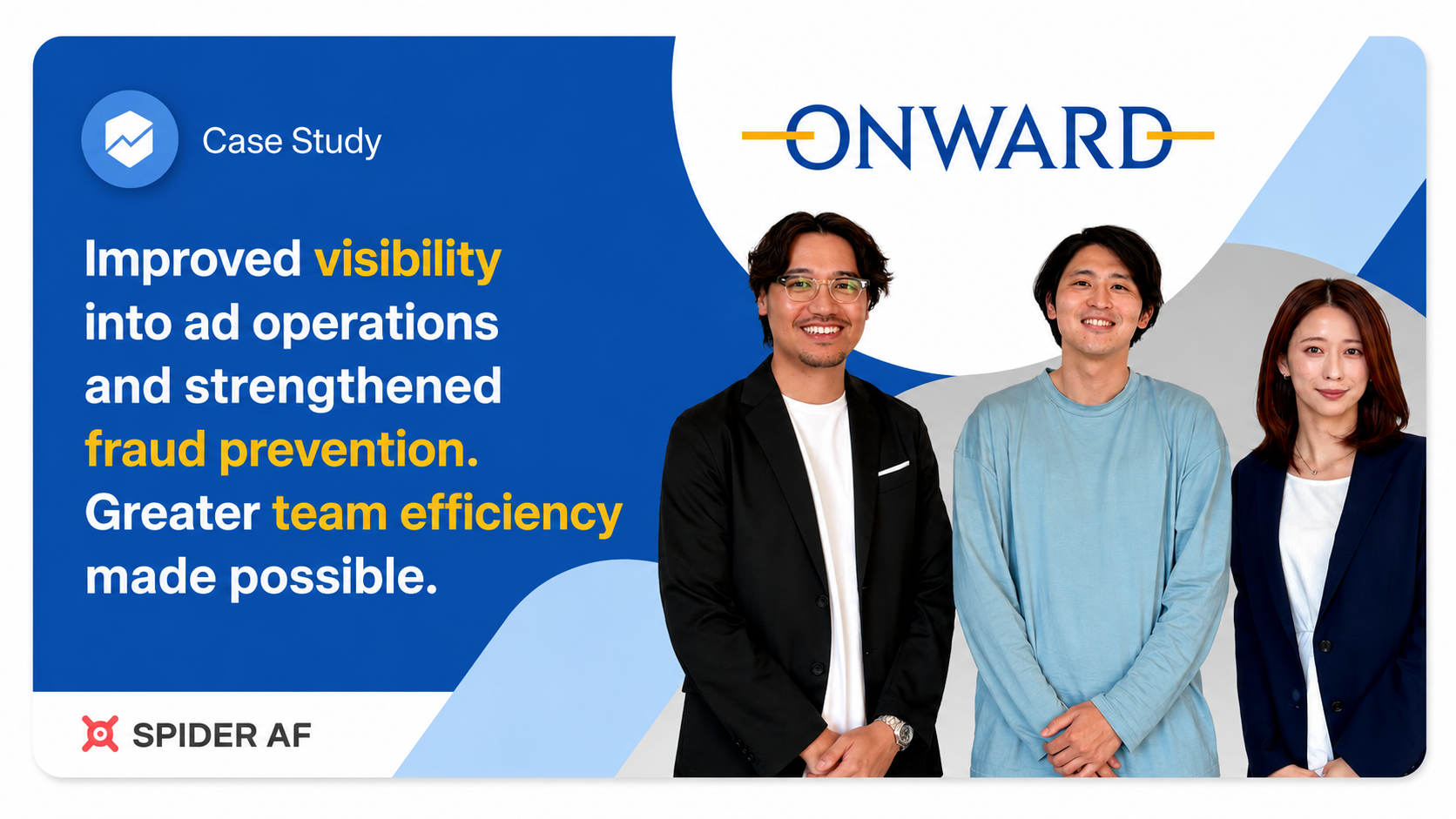
To discuss the challenge, Spider Labs brought together three perspectives: the advertiser, the agency, and the technology provider.
Participants
- Mr. Koizumi, Innovation Group, Onward Digital Lab Inc.
- Mr. Mitsuda, Manager, Internet Advertising Business Headquarters, CyberAgent, Inc.
- Ms. Yoshida, Sales Leader, Spider Labs, Inc.
The Problem with “Good Enough” Advertising Quality Controls

CyberAgent has long supported advertising operations for Onward Closet. Like many major agencies, it has maintained brand safety controls, excluded problematic domains, and followed industry standards set by organizations such as JIAA and JAA.
But even mature manual operations have limits.
“We have maintained lists of problematic media properties for many years and excluded them manually,” said Mitsuda. “We also built internal systems to apply those exclusions across campaigns as efficiently as possible.”
The challenge is timing.
Exclusion lists are only as effective as their latest update. In fast-moving advertising environments, especially across complex campaign structures, manual review can struggle to keep pace with new fraudulent domains, low-quality placements, and invalid traffic patterns.
For Onward Closet, that complexity matters. Campaigns are segmented by product category, which means poor-quality placements or invalid clicks can distort the data at a granular level. A campaign may appear underwhelming not because the offer is weak or the targeting is wrong, but because the traffic quality is polluted.
That creates a management problem: teams may be making optimization decisions based on noisy data.
“Low-quality placements and invalid traffic can make strong-performing campaigns appear ineffective,” Mitsuda said. “It becomes difficult to quantitatively evaluate whether operations are truly being managed in the optimal way.”
Why Onward Started Paying Closer Attention
Onward Digital Lab’s interest in ad fraud and brand safety began around 2019, when terms like “ad fraud” and “brand safety” started appearing more frequently in industry coverage.
At the same time, Onward Closet was growing. Sales were increasing, investment was rising, and expectations for the e-commerce business were becoming more ambitious.
For Koizumi, the issue became clear: Onward had spent decades building brand equity, but digital advertising had introduced new risks that were not always visible through standard reporting.
“As a group approaching its 100th anniversary, we realized that although we had spent decades building our brand, there were relatively few mechanisms in place to protect those brand assets within digital advertising,” he said.
There was also a cultural factor. Onward Digital Lab is a data-driven organization. The team is used to measuring, quantifying, and evaluating performance. Yet ad fraud remained difficult to see.

“We try to quantify and evaluate everything,” Koizumi said. “But despite that mindset, we had no real visibility into fraudulent activity.”
The concern was not that something was definitely wrong. It was that no one could confidently prove the opposite.
Turning Suspicion into Measurable Evidence
After implementing Spider AF, the biggest shift was visibility.
Onward had assumed that some level of fraud existed. But as long as regular advertising reports appeared to meet expectations, there was little reason to investigate deeper.
Spider AF changed that by showing the scale and types of fraudulent activity in measurable terms.
“The biggest value was being able to quantify and visualize the types and scale of ad fraud,” Koizumi said. “We had always assumed that some level of fraud existed. After implementation, we could finally see actual numbers showing how much traffic might be fraudulent.”
That visibility also made it possible to test a core hypothesis: if fraudulent traffic could be removed, ads would reach real users more effectively, improving conversion efficiency.
According to Koizumi, that hypothesis was confirmed through measurable CPA improvements.
For CyberAgent, the platform also made the problem more concrete.
“We had heard industry statistics before,” Mitsuda said. “But seeing the reality within a client account I personally managed made the issue much more tangible.”
For Onward, Spider AF excluded approximately 30,000 domains through brand safety controls alone. Several hundred thousand invalid clicks were also removed and reallocated toward legitimate audiences.
Fraud rates vary by industry and competitive environment. E-commerce generally sees invalid click rates close to the industry average of around 5%, while sectors such as recruiting and financial services often see significantly higher rates. Industries with intense competition and high CPCs are especially vulnerable, including invalid clicks generated by competitors or bots collecting market intelligence.
Does Removing Fraud Reduce Delivery?
One common concern among agencies is that removing fraudulent traffic will reduce campaign delivery volume.
Mitsuda sees the issue differently. The goal is not to reduce delivery. It is to redirect budget toward placements and audiences that should have received it in the first place.
“Rather than reducing volume, the result is that ads appear in the right places and budget is redirected toward investments that should have been made from the beginning,” he said.
In other words, campaign scale should not be judged only by impression or click volume. It should be judged by whether that volume has a realistic chance of producing business value.
Automation Without Added Workload
Another concern is operational burden.
For CyberAgent, implementing Spider AF did not replace its existing responsibility to manage quality. The agency still owns that work. But automation made the process more accurate without adding manual tasks.
“Because the platform is highly automated, it did not create additional workload,” Mitsuda said. “Instead, it improved accuracy and strengthened quality assurance.”
Onward took a particularly rigorous approach during rollout, using A/B testing to validate the impact. That required initial effort, but Koizumi noted that not every company needs to take the same level of analytical depth.
Once effectiveness was confirmed, exclusions became automated. Today, the team mainly reviews reports.
“The implementation has not increased workload for our teams,” Koizumi said.
The Business Case: Performance, Refunds, and Brand Protection
The value of ad fraud prevention is not limited to cleaner reporting.
Using Spider AF’s fraud detection logs as supporting evidence, Yahoo! provides monthly refunds for invalid traffic. Onward reinvests those refunds back into advertising.
From a management perspective, Koizumi sees the initiative through two lenses.
The first is brand protection. Preventing ads from appearing on undesirable websites is an investment in long-term brand equity.
The second is performance. If prevention costs less than the value created through improved campaign performance, it becomes a measurable business case.
“From a brand safety perspective, preventing our ads from appearing on undesirable websites is clearly an investment in protecting brand equity,” Koizumi said. “From a performance marketing perspective, it can also be evaluated as a cost-benefit calculation.”
Both matter. Brand risk is not always easy to quantify, but it can become very real very quickly.
Before implementation, Onward became aware of at least one problematic placement only because an employee happened to notice it and shared a screenshot.
“We only became aware of the issue because someone spoke up,” Koizumi said. “I suspect there were many similar cases that no one reported.”
Why Visibility Comes First
Many companies acknowledge ad fraud and brand safety as important, but delay action because the issue feels abstract.
Koizumi believes the first step is simple: make the problem visible.
“Without the initial free assessment, we would never have understood the severity of the issue ourselves,” he said. “We may have recognized the risk conceptually, but it would not have become a priority.”
Numbers create urgency. Once teams can see where ads are appearing and how much fraudulent traffic may exist, the conversation changes from theoretical risk to measurable business impact.
That visibility is also important for internal approval.
According to Koizumi, organizations often need both quantitative and qualitative evidence. Numbers show scale, but examples make the risk tangible for senior stakeholders who may not live inside digital advertising reports.
A single screenshot of a brand ad appearing on an inappropriate site can sometimes communicate risk more effectively than a dashboard. At the same time, measurable fraud volume and performance impact help connect that risk to business outcomes.
Together, the two forms of evidence make the issue harder to ignore.
The Agency’s Role in Protecting Client Budgets
For Mitsuda, the agency’s responsibility is straightforward: if a client entrusts you with their budget, you have a duty to ensure that money is used properly.
“Personally, I hate waste,” he said. “I dislike seeing money spent where it was never intended to go, and I don’t believe that would be an honest or responsible approach toward our clients.”
He also sees advertising as more than a media transaction. When done properly, advertising helps people discover options they may not have known existed.
“A piece of information delivered through advertising could change someone’s life,” he said. “There is a significant difference between not purchasing because you never knew about a product and choosing not to purchase after learning about it.”
His perspective is also shaped by previous experience on the advertiser side. Even minor placement issues can damage brand image and sales. That makes quality control not just an operational concern, but a matter of trust.
“When you are entrusted with a client’s budget, it is essential that they can clearly see and feel the value being created,” Mitsuda said.
Toward a Cleaner Digital Advertising Ecosystem
Mitsuda described advertisers and agencies as partners whose success is deeply connected.
When sales grow, advertising investment increases. When campaigns perform well, both sides benefit. But as digital advertising continues to expand, the way the industry manages quality will shape the market’s long-term credibility.
“Advertisers and agencies are, in many ways, partners whose success is intertwined,” he said.
He also noted that Japan currently ranks among the countries most heavily affected by ad fraud worldwide. Improving that situation, he argued, would increase the market’s growth potential and support a healthier advertising ecosystem.
For publicly accountable companies that receive investment from shareholders, transparent advertising operations are also part of broader business responsibility.
Koizumi echoed that point from the advertiser’s perspective.
When advertisers, agencies, and media platforms build trust, eliminate fraud and noise, and operate in a cleaner environment, everyone benefits. Onward has already seen tangible outcomes, including improved advertising performance, stronger brand protection, and refunds that can be reinvested into marketing.
His advice to advertisers is direct: do not wait for someone else to raise the issue.
“Advertisers should not simply wait for agencies to propose solutions,” Koizumi said. “They should also proactively ask: Can we start by visualizing the problem?”
A Shared Responsibility
Protecting advertising quality is not a challenge that any single party can solve alone.
Agencies need to take responsibility for the budgets they manage. Advertisers need mechanisms to protect their brands. Vendors need to provide the visibility and automation required to make those efforts practical at scale.
The first step does not have to be complicated.
For organizations that know ad fraud prevention matters but have yet to act, the starting point is simply to understand what is actually happening inside their campaigns.
Only then can they decide what needs to change.


%20ENJAL-banner(NEW).png)
%20ENJAL-banner(NEW)%20(2).png)